Mythical Creatures Word Search Scrambl: A Strategic Tool for Educational Workflows
In the landscape of modern education and creative development, finding resources that seamlessly integrate into existing workflows is essential. Mythical Creatures Word Search Scrambl represents more than a simple pastime; it is a structured cognitive exercise designed to enhance vocabulary, problem-solving abilities, and imaginative thinking. Specifically curated for children in grades 2 through 5, this engaging puzzle experience serves as a critical component in fostering a love for language while maintaining high standards of educational quality.
For educators, parents, and content creators, the challenge often lies in selecting activities that are both entertaining and pedagogically sound. This tool addresses that need by combining the mechanics of word searches with the linguistic challenges of scrambling letters. The result is a dynamic learning asset that fits naturally into lesson plans, home schooling routines, and extracurricular enrichment programs. By understanding how to implement Mythical Creatures Word Search Scrambl effectively, users can transform passive playtime into active skill-building sessions.
Defining the Resource and Its Core Mechanics
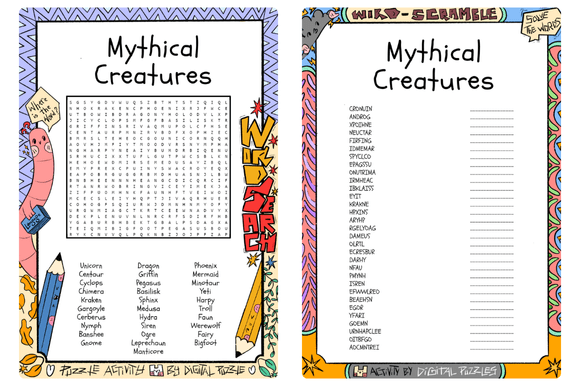
Mythical Creatures Word Search Scrambl is a specialized worksheet series that invites learners to uncover the secrets of fabled beasts like unicorns, griffins, dragons, and phoenixes. Unlike traditional word searches where words are hidden horizontally or vertically in a fixed grid, this variation introduces a layer of complexity through scrambled letter sequences. Users must first unscramble the letters to form the correct mythical creature name before locating it within the puzzle grid.
This dual-layered approach requires a higher degree of cognitive engagement. It forces the brain to process phonics, spelling patterns, and visual recognition simultaneously. For the target audience of grades 2-5, this level of difficulty is carefully calibrated to be challenging without being discouraging. The inclusion of solutions ensures that immediate feedback loops are established, allowing learners to self-correct and teachers to quickly assess progress. This feature makes the resource highly compatible with self-directed learning models where adult supervision may be intermittent.
Integration into Learning and Creative Processes
The true value of Mythical Creatures Word Search Scrambl emerges when it is viewed as part of a broader educational workflow rather than an isolated activity. In a classroom setting, this resource can serve multiple functions depending on the stage of the lesson plan.
- Pre-Assessment and Warm-up: Teachers can use the puzzles at the start of a unit on mythology or folklore. This activates prior knowledge and primes students' brains for new vocabulary related to ancient stories and cultural legends.
- During Instruction: As a mid-lesson activity, the scramble aspect reinforces spelling rules and letter manipulation skills. It acts as a break from direct instruction while keeping students engaged with the topic's core terminology.
- Post-Lesson Reinforcement: After reading a story about a specific creature, students can use the puzzle to solidify their understanding of the character names and traits associated with them.
For homeschoolers and private tutors, the flexibility of this tool allows for differentiated instruction. A student struggling with spelling might benefit from the visual aid of the word search, while an advanced learner can be challenged to write sentences using the discovered creatures after completing the scramble. This adaptability ensures that the resource remains relevant across various proficiency levels within the same age group.
Strategic Implementation for Educators and Creators
When integrating Mythical Creatures Word Search Scrambl into a curriculum or digital platform, several factors regarding preparation, usability, and organization come into play. Efficiency is key; educators often have limited time to prepare materials, so the ease of access and printability of these worksheets is a significant advantage.
To maximize efficiency, consider the following implementation strategies:
- Thematic Alignment: Ensure the mythical creatures featured in the puzzle align with your current thematic units. If studying Greek mythology, prioritize puzzles featuring Zeus, Medusa, or Pegasus. If focusing on global folklore, select creatures from Asian or African traditions. This contextual relevance deepens the learning outcome.
- Progressive Difficulty: Utilize the variety of puzzles available to create a progression path. Start with simpler scrambles and shorter word lists for younger students (Grade 2) and gradually introduce longer, more complex creature names for older students (Grade 5). This scaffolding approach supports consistent growth without overwhelming the learner.
- Collaborative Elements: Transform individual work into a collaborative project. Have small groups compete to solve the scramble first, then work together to find the words in the grid. This fosters communication skills and peer-to-peer teaching, which are vital components of social-emotional learning.
For digital creators and bloggers looking to incorporate this content, Mythical Creatures Word Search Scrambl offers excellent potential for generating traffic and user engagement. Embedding interactive versions of these puzzles or offering printable PDF downloads can increase time-on-site metrics. When creating content around these puzzles, focus on the educational benefits—such as vocabulary expansion and pattern recognition—to appeal to parents and teachers searching for high-quality, screen-free activities.
Quality Control and Long-Term Utility
A common pitfall in educational resource selection is choosing materials that lose their appeal after a single use. To ensure long-term utility, Mythical Creatures Word Search Scrambl should be treated as a reusable asset. The provided solutions allow for repeated practice without the need for constant teacher intervention. Students can complete the puzzle, check their answers, and immediately attempt a different version or a harder difficulty level.
Furthermore, the consistency of the design helps in building a routine. When students recognize the format of the puzzle, they spend less time deciphering instructions and more time engaging with the content. This consistency reduces cognitive load regarding the task itself, allowing mental energy to be directed toward the actual learning objectives. For organizations managing large libraries of learning materials, having a standardized format like this simplifies cataloging and retrieval.
Enhancing Problem-Solving and Imagination
Beyond the mechanics of spelling and searching, this tool ignites imagination by connecting abstract letter patterns to concrete mythical concepts. The process of decoding a scrambled word like "G-R-I-F-F-I-N" and associating it with a legendary beast creates a strong neural link between language and imagery. This connection is particularly powerful for visual learners who thrive on seeing the relationship between text and concept.
In a business or professional context, the principles behind this activity mirror the skills required for strategic planning and problem-solving. Just as a student must analyze the scrambled letters to find the solution, professionals must analyze fragmented data points to reach a conclusion. While the stakes are lower in a classroom setting, the cognitive muscle memory built through these puzzles translates to better analytical habits. Encouraging children to visualize the creature as they solve the puzzle also enhances their creative visualization skills, a trait valuable in any field from marketing to engineering.
Accessibility and Inclusivity
The design of Mythical Creatures Word Search Scrambl inherently supports inclusivity. The visual nature of the word search aids students who may struggle with pure text-based tasks. The inclusion of solutions removes the frustration of getting stuck, promoting a growth mindset where mistakes are viewed as part of the learning process. For English Language Learners (ELL), the repetitive exposure to creature names in a fun context accelerates vocabulary acquisition without the pressure of formal testing.
By providing a tool that is both accessible and engaging, educators can ensure that all students, regardless of their starting point, can participate meaningfully in the activity. This democratization of learning opportunities is a hallmark of effective educational planning. Whether used in a bustling public school classroom or a quiet home study corner, the resource adapts to the environment while maintaining its core educational integrity.
Conclusion: Mastering the Mythical Realm
Mythical Creatures Word Search Scrambl stands out as a versatile and practical tool for anyone involved in the education of children in grades 2-5. It successfully bridges the gap between entertainment and education, offering a structured yet flexible way to enhance vocabulary and problem-solving skills. By integrating this resource thoughtfully into daily routines, lesson plans, or creative projects, adults can provide learners with a magical journey that builds real-world competencies.
The inclusion of solutions adds a layer of reliability, making it a safe bet for busy educators and parents who need dependable materials. As you look to optimize your workflow and foster a love for language in your learners, consider how this puzzle experience can fit into your strategy. Let your learners become puzzle masters of the mythical realm, one unscrambled word at a time, and watch as their confidence and capabilities soar alongside their imagination.